Monday, September 14, 2026
If You Stop Hiring Juniors, Who Are Your Seniors in 2031?
In June I wrote that AI didn't kill engineering jobs, and I stand by it — in aggregate. But an aggregate can hide a hole, and this one does. The hole is at the bottom of the ladder.
Entry-level developer hiring is down by roughly two-thirds since 2022, by the figures most often cited. One widely reported payroll study found employment of 22-to-25-year-olds in AI-exposed jobs, software development included, fell about 13% after GPT-4 while senior roles kept growing. In LeadDev's AI Impact Report, 54% of engineering leaders said they expect AI coding tools to reduce junior hiring over the long term.
I understand the logic, because I hear it in planning meetings. A senior engineer with a capable agent now covers the work that used to justify a junior hire. The tickets you'd have handed a new grad — the small bug, the test coverage, the CRUD endpoint — are exactly the tickets agents handle well. Why add a headcount that needs six months of mentoring to do what a $200 tool does today?
It's a reasonable answer to this year's budget. It's a bad answer to the question in the title.
The arithmetic nobody runs
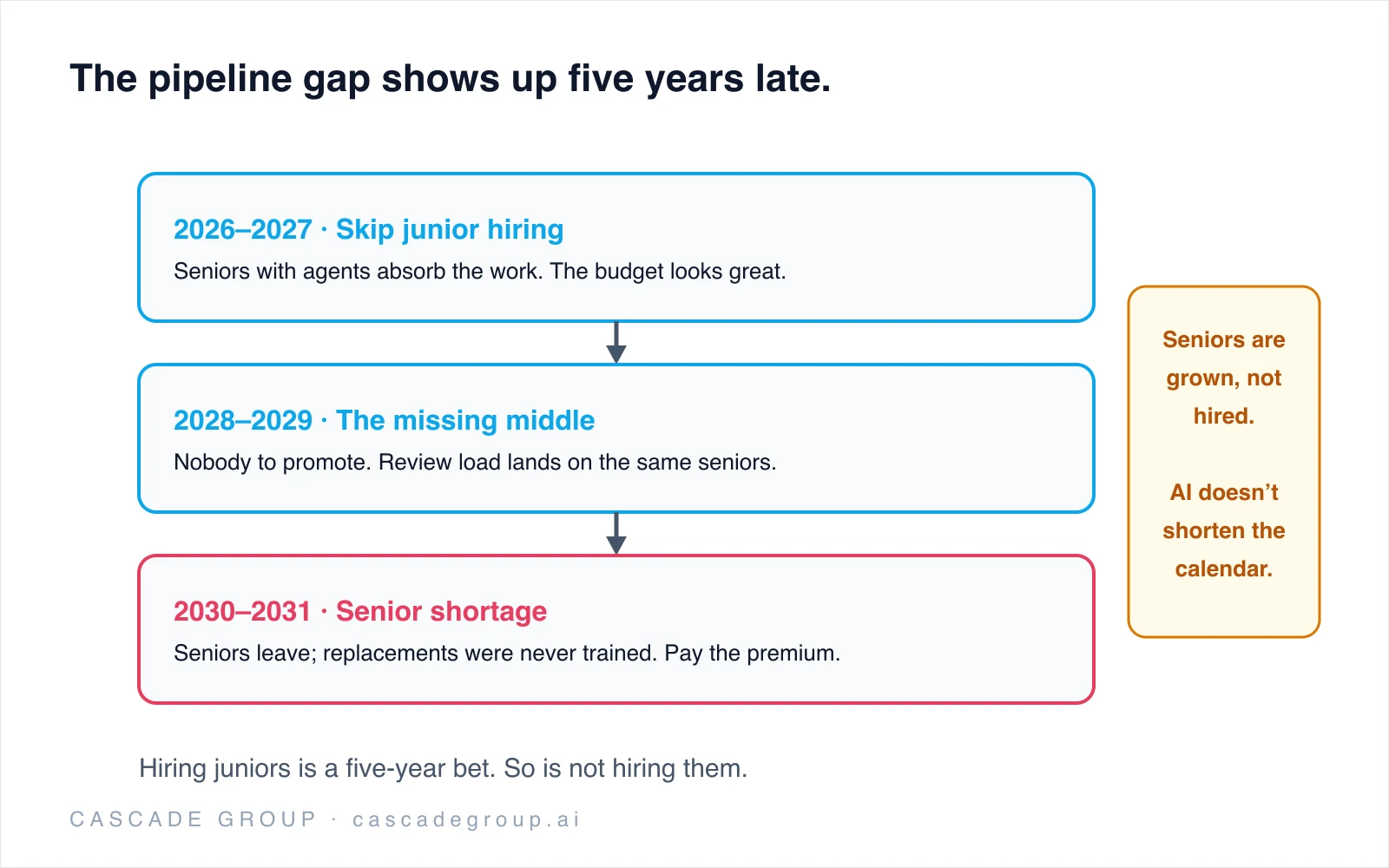
Seniors aren't hired. They're grown, and it takes years of shipping, breaking, and fixing real systems. No model release shortens that calendar.
So a team that stops hiring juniors in 2026 has no mid-level engineers to promote in 2029, and no new seniors in 2031. Meanwhile the seniors it has are carrying more: more review, more architectural judgment, more supervision of agent output. When they leave, the replacements were never trained — by you or, if the rest of the industry made the same call, by anyone.
Mark Russinovich and Scott Hanselman made this case in Communications of the ACM this spring. Their point is that agentic tools give seniors a large boost while imposing what they call "AI drag" on early-career developers who lack the judgment to evaluate what the agent produced. Every individual company's incentive is to hire experienced people and automate the rest. Collectively, that drains the pool everyone hires from.
The junior job changed. It didn't disappear
IBM is making the opposite bet. Its CHRO, Nickle LaMoreaux, said this year that the company will triple entry-level hiring in the US — and that it rewrote the job descriptions first. Her framing was direct: the entry-level job of two or three years ago can largely be done by AI, so the role has to deliver something else. IBM's junior developers now spend less time on routine coding and more time with customers.
That's the right move, and you don't need IBM's scale to copy it. The old junior role was "write the easy code." The new one looks more like this:
Verification first. Juniors review, test, and reproduce agent output before a senior sees it. It's real work, it removes load from your most constrained people, and it's the fastest way I know to learn a codebase.
Requirements and customer contact. The scarce skill now is specifying the right thing. Put juniors closer to the problem — support rotations, customer calls, writing the spec the agent will work from.
Deliberate apprenticeship. Russinovich and Hanselman propose a preceptor model borrowed from medicine: a senior paired with an early-career engineer on a real product team, with learning as an explicit goal. The senior watches how the junior works with the agent and teaches judgment, not answers.
Some work done by hand. Not as hazing. You can't evaluate a migration an agent wrote if you've never written one.
A small bet with a long payoff
For a 50-engineer team this isn't a hiring wave. It's two or three early-career hires a year, with a role designed for how the work is actually done now and a named senior responsible for each.
That costs something today. So does the alternative, and its bill arrives in 2031, at market rates, in a market where everyone else is short of the same people.
Designing how juniors and seniors work alongside agents — who delegates, who verifies, who learns what — is the kind of thing we build with teams in workflow coaching.