Monday, July 6, 2026
The AI ROI Question Your Board Will Ask This Quarter
Two years ago, AI coding tools were a rounding error — twenty dollars a seat, expensed without a second thought. Today, teams running serious agentic workflows are paying $100 to $200 per engineer per month, plus usage-based agent spend that can multiply that. For a 100-engineer org, that's a line item with six figures on it. Line items with six figures on them get questions.
So sometime this year — maybe at your next board meeting, maybe in budget season — someone is going to ask: what are we getting for the AI spend? Half the engineering leaders I know are dreading that question. It's worth being one of the ones who isn't.
The answers that don't survive the room
A few responses show up constantly and fail predictably.
"Everyone's doing it" isn't ROI, it's momentum, and boards can tell the difference. Vendor statistics — the famous 55%-faster numbers — describe controlled studies of other people's engineers on other people's tasks; a sharp board member will ask what happened at your company, and vendor benchmarks have no answer. And developer-satisfaction surveys are worth collecting, but "the engineers like it" priced at $150K a year sounds like a perk, not an investment.
The common failure in all three: they measure activity or sentiment, not delivery. Value doesn't exist until working software reaches production.
The answer that does
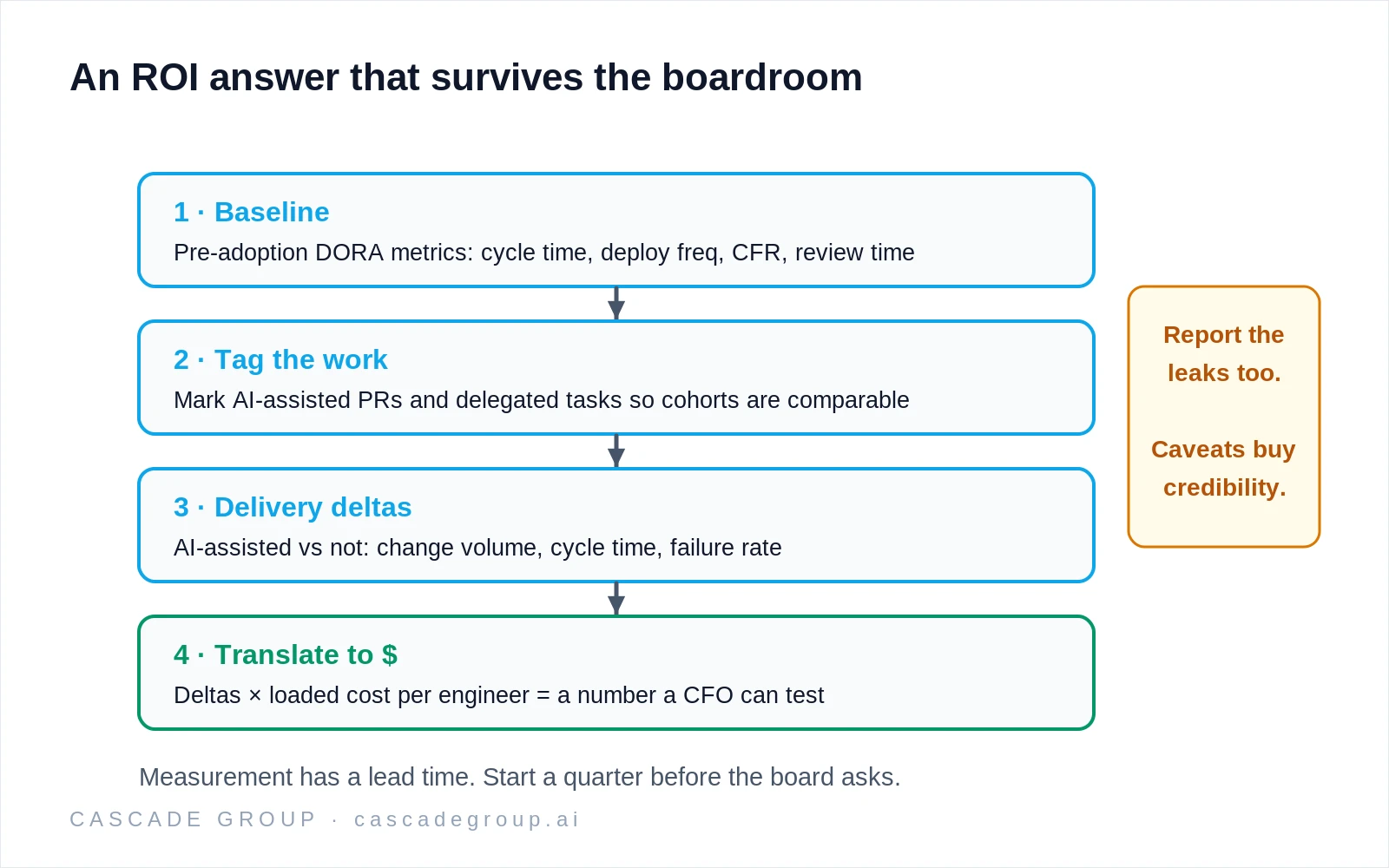
The credible answer has three parts, and none of them requires a data science team.
A baseline. Delivery metrics — cycle time, deployment frequency, change failure rate, review time — from before adoption ramped, or at worst from your lowest-adoption teams as a comparison group. Without a baseline you have anecdotes. If you don't have one yet, start today; even a late baseline beats none, because your adoption depth is still climbing and the comparison is still ahead of you.
A connection to throughput. The chain the board actually cares about: engineers delegate more → cycle time drops → the roadmap moves faster or the same roadmap needs less contract spend. DORA's ROI framework published earlier this year is a solid template for making that translation from engineering metrics to business value without hand-waving. What you're looking for is honest arithmetic: "AI-assisted teams shipped X% more change volume at equal or better change-failure rates, which at our loaded cost per engineer works out to Y" is a sentence a CFO can work with.
The honest caveats. Counterintuitively, the caveats make the story stronger. If review time went up while generation sped up, say so, and show what you're doing about it. Boards have seen enough AI hype to discount a story with no costs in it. A leader who reports "here's the gain, here's where it's leaking, here's the fix" reads as someone managing an investment rather than defending a purchase.
The real deadline
Here's the thing about the board question: by the time it's asked, it's too late to instrument the answer. Measurement has a lead time — you need a quarter or two of data before the story is defensible. The leaders who will look good next budget season are the ones who started counting this summer.
The spend is only going up. Agents are getting more capable and more expensive, and "we don't really measure it" is aging from common to negligent. Get the baseline, tag the AI-assisted work, watch the delivery metrics, and the ROI question stops being a threat and starts being your best slide.
Standing up exactly that measurement and reporting loop is what our adoption reporting engagement does — data your board will actually believe.