Monday, May 25, 2026
MCP Won. What That Actually Means for Your Engineering Team
Eighteen months ago, Anthropic published a specification for how AI systems should connect to external tools and data. It got a polite reception and a wave of "yet another standard" skepticism. Today, the Model Context Protocol is the de facto integration layer of the enterprise AI economy. Every major model provider supports it, every serious dev tool speaks it, and the connector ecosystem has become a real market of its own.
Standards wars usually take a decade and end in a draw. This one took a year and a half and ended decisively. If you run engineering at a mid-size company, that outcome quietly changed a few of your decisions.
Integration risk just dropped
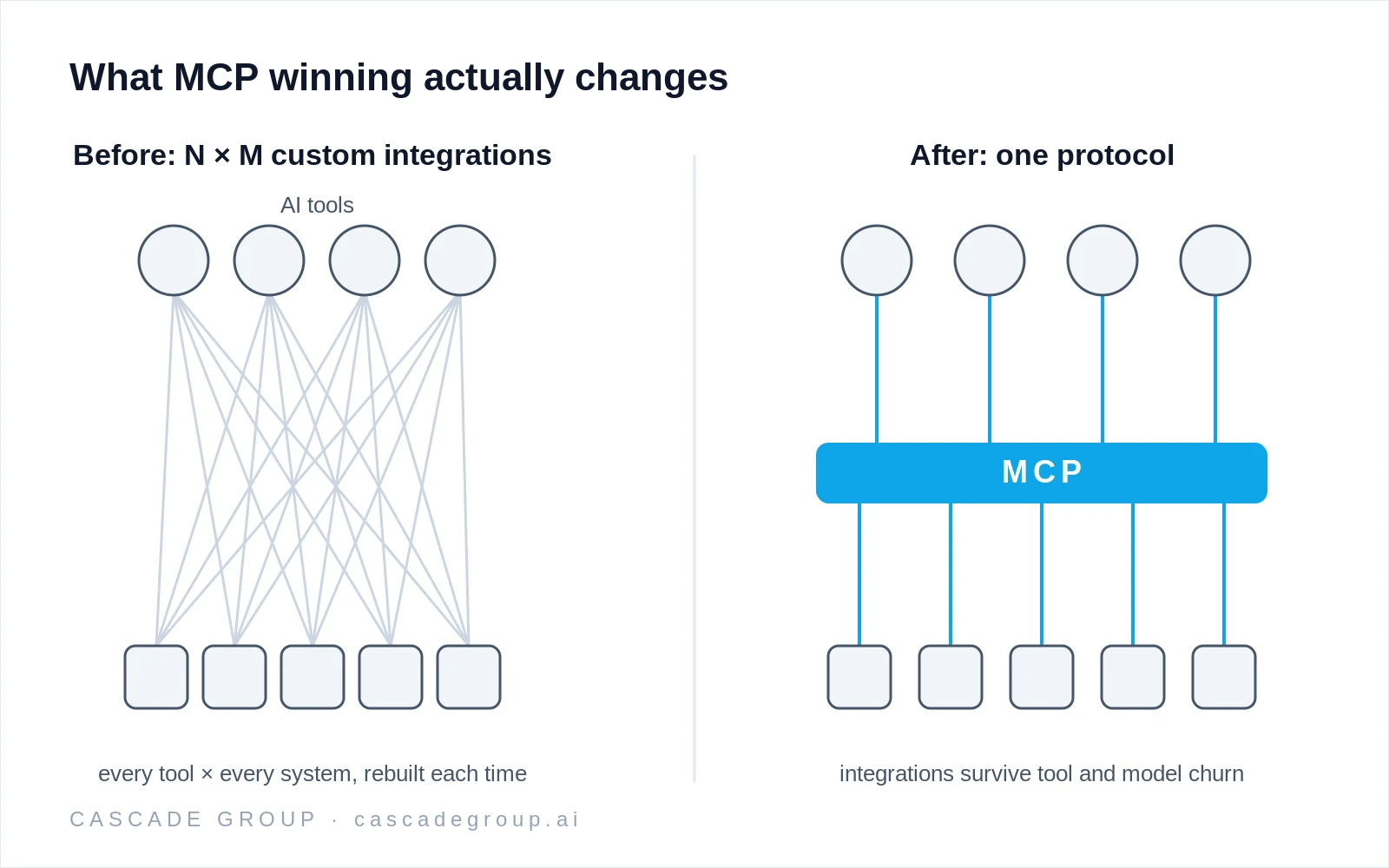
The strongest argument for delaying AI investment used to be lock-in. Build your workflows around one vendor's plugin system, and you're stuck when the landscape shifts — and the landscape shifts every quarter.
MCP mostly dissolves that argument. When your internal tools, data sources, and services are exposed as MCP servers, they work with whatever model or agent you point at them — today's and next year's. The integration work survives the tooling churn. That changes the calculus for teams that have been waiting on the sidelines: the "we'll get locked in" objection is now largely obsolete, and it's worth asking whether your hesitation has outlived its reason.
Your internal systems are now the differentiator
Here's the second-order effect that matters more. When every competitor has access to the same models and the same tools, the differentiating question becomes: what context can your AI reach that theirs can't?
The teams getting outsized value from AI right now are the ones that have exposed their internal world — ticketing, docs, observability, deployment systems, domain databases — through MCP servers. Their agents don't just write generic code; they write code informed by the team's actual runbooks, incidents, and conventions. That's not a model advantage. It's an integration advantage, and it's built with ordinary engineering work your team already knows how to do.
A practical starting point: list the five systems your engineers consult most while working — the wiki, the issue tracker, the logs, the schema docs, the deployment dashboard. Every one of those that isn't reachable by your AI tooling is context your expensive assistant doesn't have.
The boring part: governance
A standard connector protocol also means a standard attack surface. An MCP server that exposes your production database to an agent is exactly as dangerous as it sounds if nobody thought about permissions. Treat MCP servers like any other service: authenticated, scoped, logged, and reviewed. The protocol won; your security model still has to do its job. Mid-size teams have an advantage here — you can put sane guardrails in place now, before the connector sprawl that larger enterprises are already fighting.
What to do this quarter
Three moves, none of them dramatic. Inventory which of your internal systems have MCP servers available off the shelf — the ecosystem is bigger than you think. Pick one high-leverage internal system that doesn't, and build the server; it's usually days of work, not weeks. And write down your rules for what agents can reach, before someone connects something they shouldn't.
The protocol question is settled. The remaining question is whether your team's context is plugged in — and that's now purely an execution problem.
Figuring out which integrations would actually move the needle for your team is the kind of thing we dig into during workflow coaching.