Monday, June 1, 2026
From Five Enthusiasts to Fifty Engineers: Crossing the AI Adoption Gap
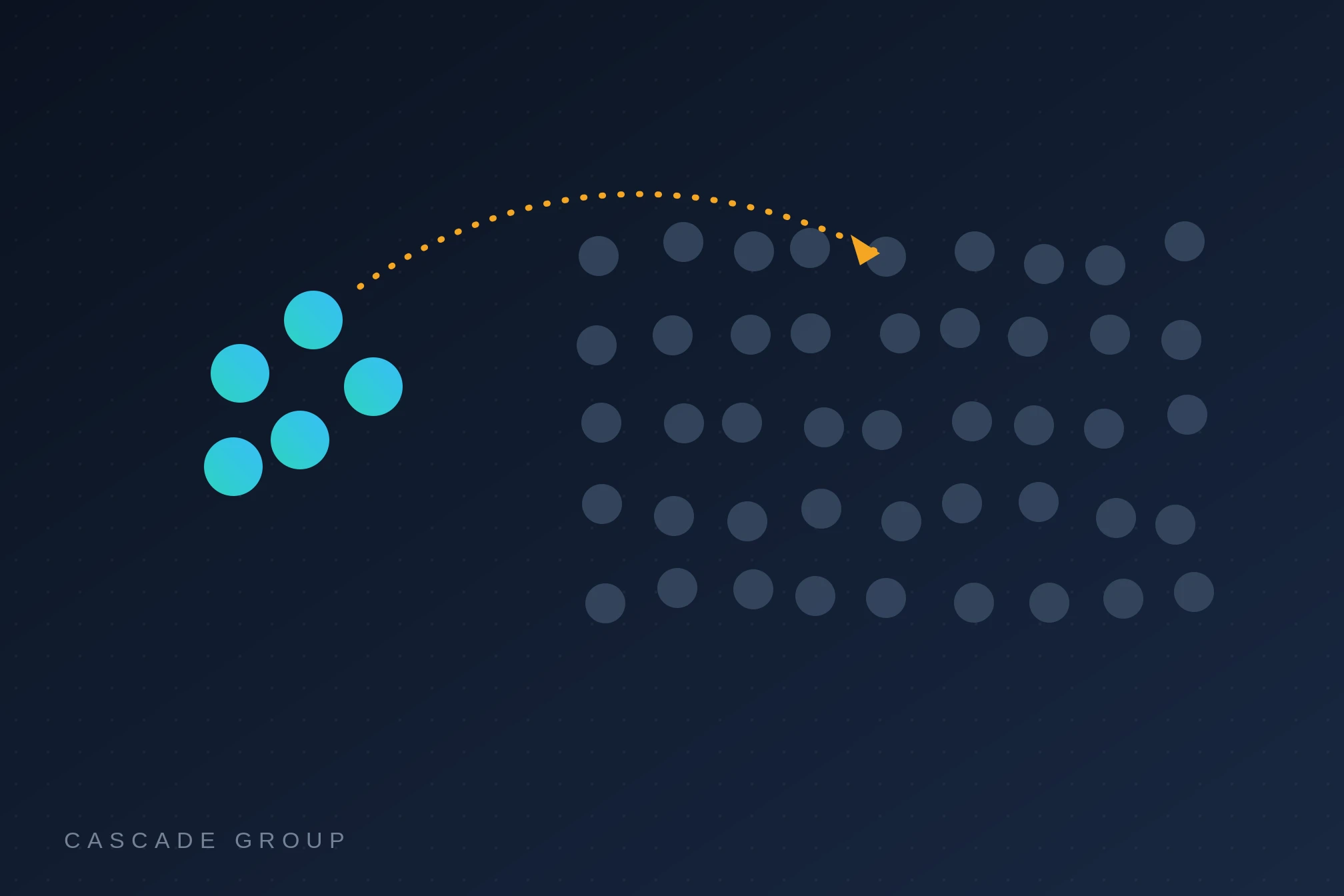
Every engineering org I work with has the same shape of problem. Five engineers are all-in on AI tooling — they've customized their setups, they delegate whole tasks, they're visibly faster. Forty-five engineers are somewhere between indifferent and quietly skeptical. And the leadership team is reporting the five as if they were the fifty.
Industry surveys say roughly three-quarters of engineering teams now use AI tools daily, and the number keeps climbing. But "the team uses AI" and "some people on the team use AI" are different claims, and the gap between them is where most of the unrealized ROI in your budget lives.
Why the gap doesn't close on its own
The natural theory is diffusion: enthusiasts demonstrate value, everyone else follows. Eighteen months into this wave, I can tell you the natural theory is wrong. The gap doesn't close on its own. It widens.
Power users compound. Every week they get better at prompting, delegating, and reviewing AI output, which makes the tools more valuable to them, which makes them invest more. Meanwhile, the skeptic's first bad experience — a hallucinated API, a subtly wrong refactor — confirms the prior, and they retreat to what they know. Both groups are responding rationally to their own experience. That's exactly why the distribution is stable.
There's also a quieter factor: your best non-adopters are often your best engineers. They're productive without AI, they have the least patience for tools that waste their time, and they've earned the standing to opt out. Writing them off as laggards is a mistake — when a strong senior engineer finally moves, half their team moves with them.
What actually moves the middle
Three things work, and none of them are mandates.
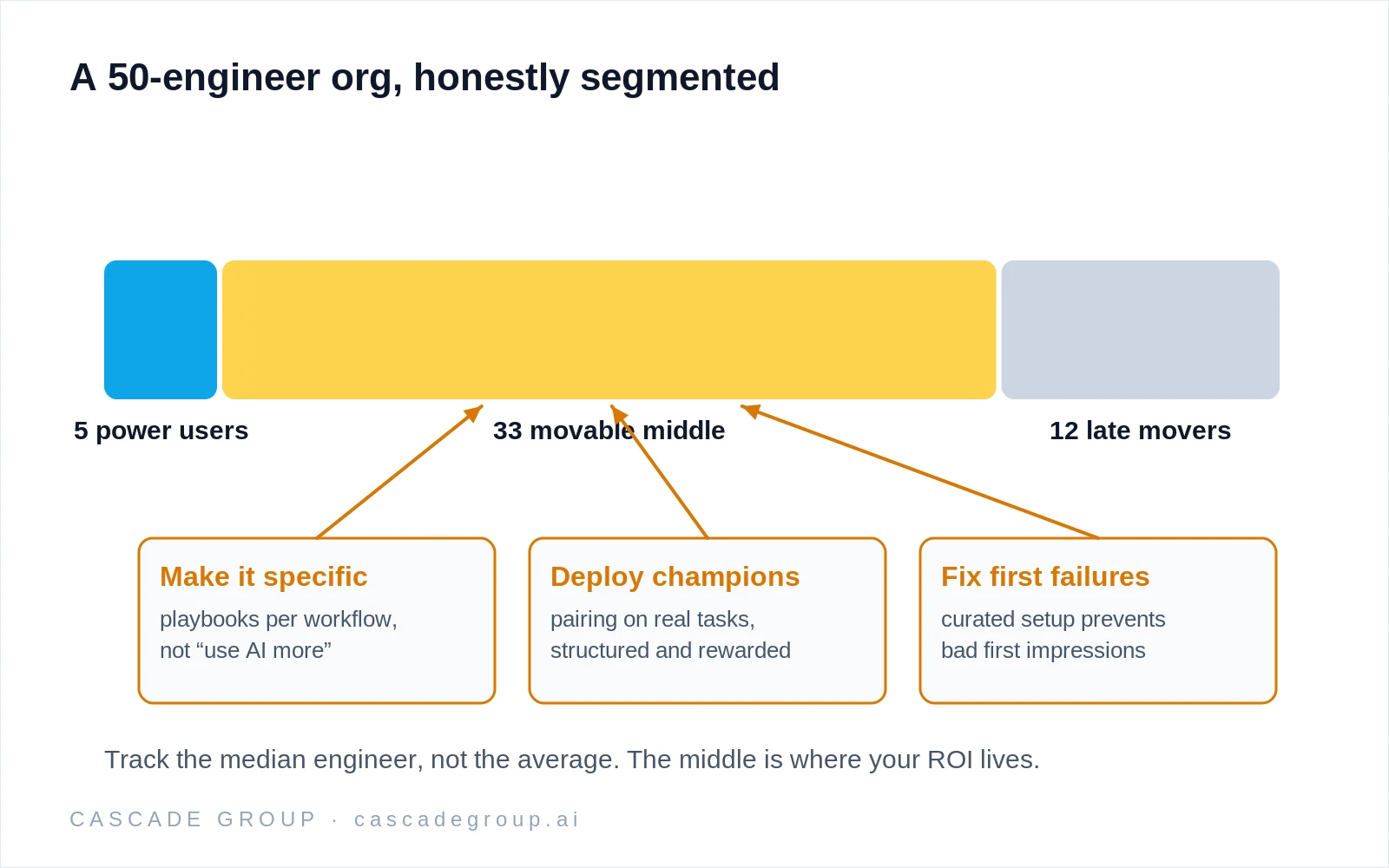
Make it specific. "Use AI more" fails. "Here's how we now write migration scripts on this team, here's the prompt pattern, here's a recorded fifteen-minute walkthrough by someone you respect" works. Adoption spreads workflow by workflow, not by exhortation.
Deploy your enthusiasts deliberately. Your five power users are your most underused asset, but enthusiasm doesn't transfer through demos of impressive results. It transfers through pairing on the skeptic's actual task, on the skeptic's actual codebase, including the failures and the workarounds. Structure that. Give champions time for it, make it part of how they're evaluated, and pick champions for credibility, not just enthusiasm.
Fix the first-failure experience. Most non-adopters aren't ideologically opposed; they got burned early and never came back. Ask what happened. You'll usually find fixable problems — no repo-level context, no shared configuration, nobody told them which tasks the tools are actually good at. A curated starting setup eliminates a whole class of bad first impressions.
Measure the median, not the mean
If you track one number through this, make it the median engineer's usage, not the average. Averages are flattered by power users. The median tells you whether the middle of your org is actually moving. When your median engineer has AI meaningfully embedded in at least one weekly workflow, you've crossed the gap. Until then, you have a pilot program with good PR.
The uncomfortable truth is that this is management work, not tooling work. The vendors have done their part; the tools are good enough. What's left is the organizational part — and that has never once solved itself.
Building this kind of champion structure is exactly what our champion enablement engagement does, if you'd rather not figure it out from scratch.