Monday, May 11, 2026
DORA's ROI Report Says the Quiet Part Out Loud: AI Is a Multiplier, Not a Fix
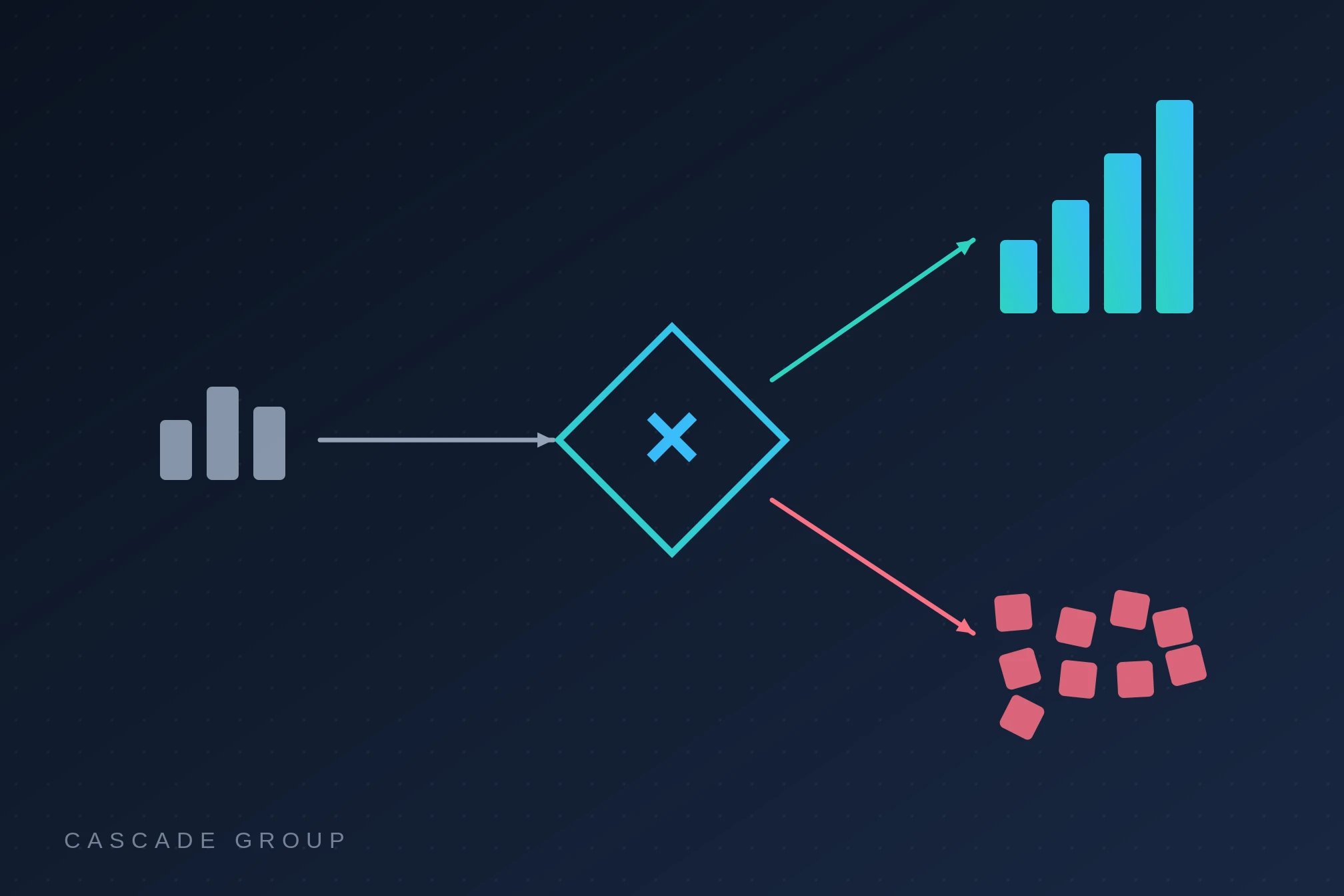
The DORA team's ROI of AI-assisted Software Development report has been making the rounds this month, and it deserves the attention. Not because it says anything shocking, but because it puts data behind something every practitioner has watched happen firsthand: AI doesn't improve your engineering organization. It amplifies it.
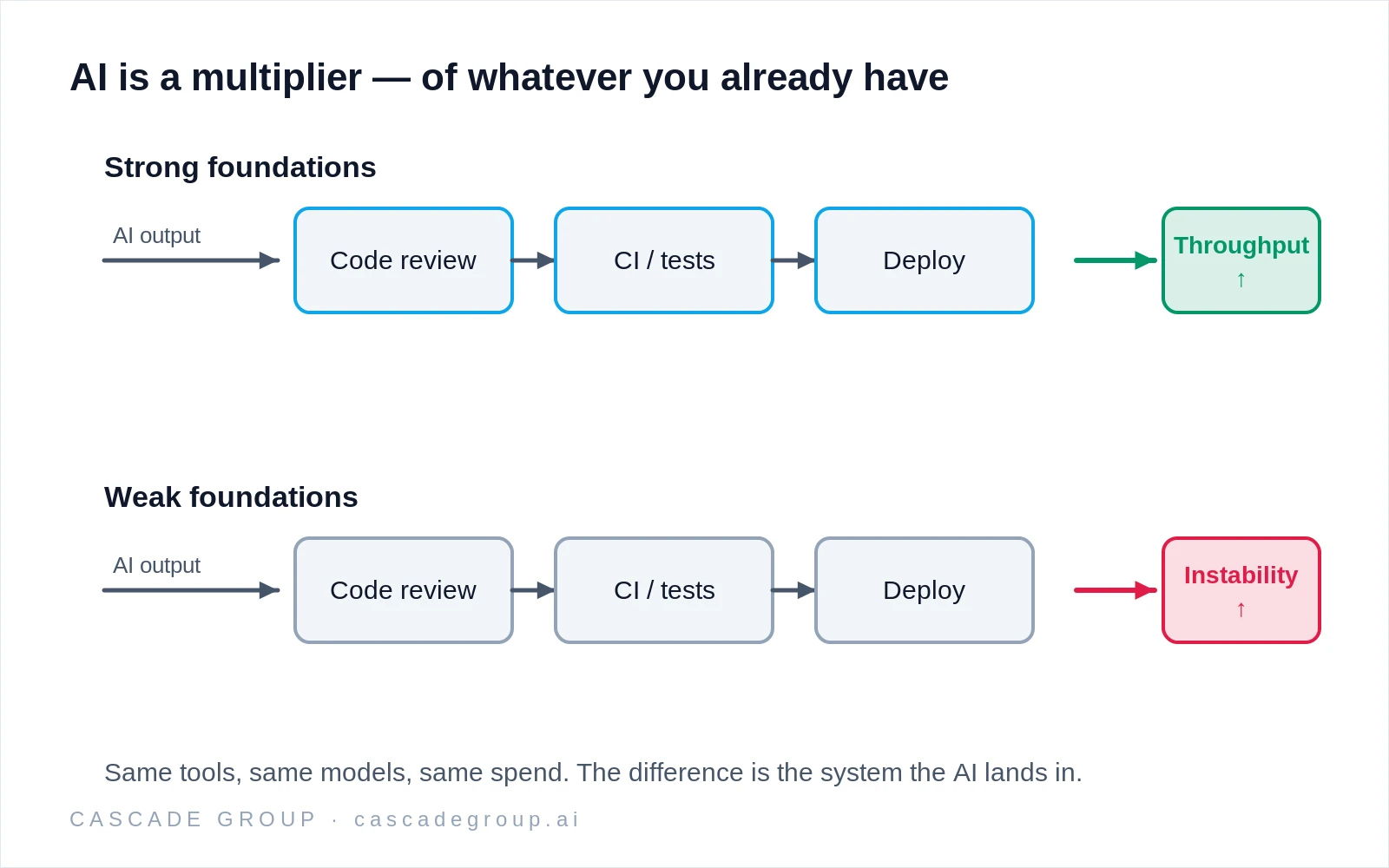
If your delivery pipeline is solid, your review culture is healthy, and your teams have clear ownership, AI assistance makes all of that faster. If your deployment process is fragile and your review queue is already a bottleneck, AI makes that worse — because now more code is arriving faster at the exact points where your system already struggles.
DORA calls this the multiplier effect. I'd call it the least surprising finding in the industry, and also the most ignored.
The uncomfortable math
The report lays out a structured model for translating engineering metrics into business value, which is genuinely useful — most ROI conversations about AI tooling are still napkin math built on vendor-reported time savings. But the finding worth sitting with is this one: AI adoption is associated with increased individual effectiveness and increased delivery instability at the same time.
Read that again. Your engineers really are moving faster. And your system may be shipping worse. Both things are true, and if you're only measuring the first one, your ROI story is fiction.
This is the trap of measuring AI at the individual level. Time-saved surveys and acceptance rates all live upstream of where value is actually realized — working software in production. Between an engineer accepting a suggestion and a customer getting value, there's review, integration, testing, and deployment. AI floods that middle section with volume. Whether your organization converts that volume into throughput or into instability depends entirely on the foundations you had before you bought a single license.
What this means if you run engineering
First, stop treating AI ROI as a tooling question. The report is blunt about this: organizations with mature platform capabilities and well-defined workflows convert AI gains into delivery performance. Organizations without them don't. The tool is a constant; your system is the variable.
Second, baseline your delivery metrics now if you haven't. You cannot claim AI improved cycle time, change failure rate, or deployment frequency if you don't know what they were before adoption ramped. I still talk to VPs of Engineering who are eight months into a Copilot rollout with no baseline. That story doesn't survive contact with a CFO.
Third, look at where the amplification is landing. If AI is a multiplier, the highest-ROI work might not be an AI initiative at all. It might be fixing the review bottleneck, the flaky test suite, or the deployment process that AI-accelerated output is now piling up behind. Unsexy, but that's where the leverage is.
The credibility test
There's a version of this report's message that sounds like an excuse — "AI didn't work because you weren't ready." That's not the right reading. The right reading is that AI's ROI is real and measurable, but it accrues to teams that treat adoption as a systems problem, not a purchasing decision.
The good news: engineering conditions are fixable, and the payoff is now doubled. Every improvement you make to your delivery system pays out twice — once on its own, and once as a bigger multiplier on your AI spend.
If you want to know which of your conditions AI is currently amplifying — the good ones or the bad ones — that's a measurable question. Our adoption reporting work exists to answer it with data instead of vibes.