Monday, June 29, 2026
AI Didn't Kill Engineering Jobs. Tell Your Team
TechCrunch ran a piece last week with a headline that would have sounded absurd in 2023: AI was supposed to kill engineering jobs, but new data suggests they're the most resilient. The underlying analysis from SignalFire found that through the most aggressive period of AI adoption in software history, engineering held up better than nearly every other function.
I want to make two arguments about this. First, the result shouldn't surprise anyone who's watched real teams adopt these tools. Second — and this is the part for engineering leaders — the fear on your team is still real, it's still affecting your adoption numbers, and this data is a tool you should be using.
Why engineering absorbed AI instead of being replaced by it
The replacement thesis always rested on a bad model of the job: that engineering is typing code, and if machines type code, engineers are redundant. But typing was never the constraint. Understanding the domain, deciding what to build, evaluating tradeoffs, catching the confident wrongness in a plausible-looking diff — that's the job, and AI made that judgment layer more valuable, not less, because there's now vastly more output to exercise judgment over.
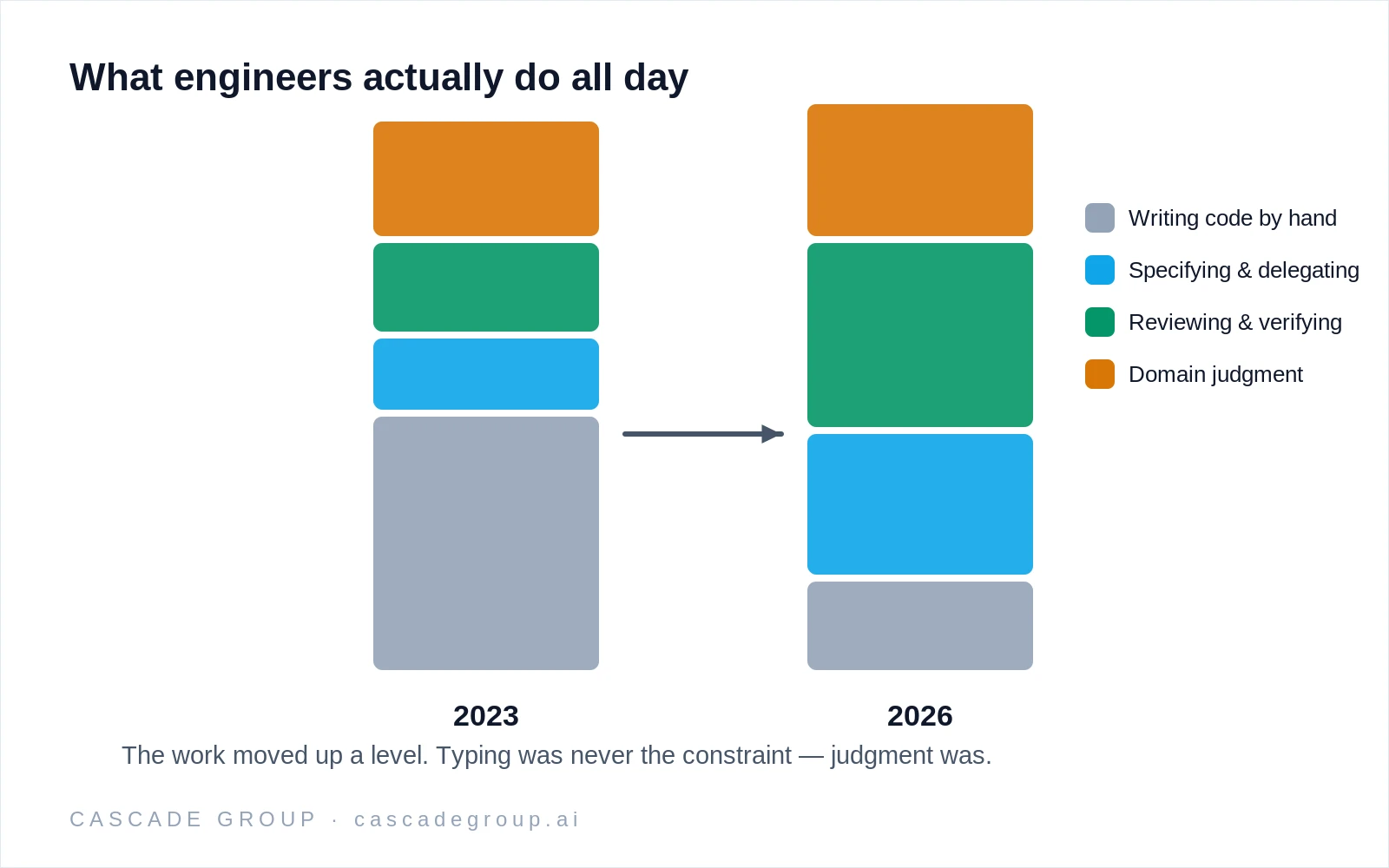
What actually happened on the ground is that the work moved up a level. Engineers who used to write migrations now specify, delegate, and review them. Demand for software didn't stay fixed while costs fell — backlogs that were never economical before suddenly became viable, and the work expanded to absorb the capacity. Every mid-size company I work with has more validated engineering work queued today than in 2023, not less.
None of this was guaranteed, and it isn't a promise about the next decade. But three years into the most capable coding AI ever deployed, the evidence says engineering adapted rather than shrank.
The part leaders keep skipping
Here's why this belongs on your desk and not just in your reading list: some meaningful fraction of your team still privately believes they're training their replacement. They won't say it in standup. It shows up instead as quiet non-adoption — the engineer who never quite gets around to the new tools, not from laziness, but because every hour of skill they build with AI feels like an hour spent digging their own grave.
You cannot fix that with a tooling mandate. Mandating adoption to someone who fears replacement reads as "accelerate your own obsolescence," and they will comply minimally and slowly. I've watched this dynamic quietly cap adoption at organizations that couldn't figure out why their rollout stalled.
What works is saying the quiet part out loud. Put the SignalFire data in front of your team. Tell them explicitly what you're planning: that AI leverage means doing the backlog you couldn't afford before, not doing the same roadmap with fewer people — assuming that's true, and if it isn't, your adoption problem is the least of your issues. Then make the new skills a promotion criterion rather than a threat: the engineers who get good at delegation and review are becoming more valuable, and your career ladder should say so on paper.
Adoption is ultimately a trust problem before it's a training problem. The data finally supports the reassuring version of the story. Use it deliberately, because your silence is currently being filled by headlines from 2023.
Team-level fear is one of the friction sources we measure directly in our AI readiness assessment — it shows up in the data more often than most leaders expect.